
A Native Wildflower with More to Offer Than Ice
Frostweed (Verbesina virginica) is best known for its mesmerizing display of “ice ribbons” that appear at the first frost. However, the focus placed on this phenomenon overlooks a critical role it plays — a friend to a variety of pollinators. It provides this lifeline at a crucial time, just before winter sets in and food sources for pollinators become scarce.
Habitat and Characteristics
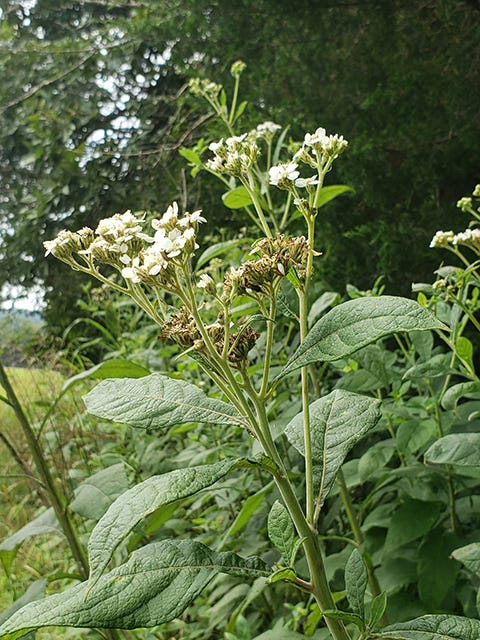
Frostweed is native to a wide swath of the southeastern United States, from Florida to the Carolinas and to the eastern half of Texas. It is an impressive perennial, often reaching over six feet tall. A remarkably resilient plant, it thrives in shade to part-shade, in various soil types, and prefers moist conditions; but once established, it can tolerate periodic dryness. In the wild, it naturally colonizes under the canopy of large trees or along streambanks.
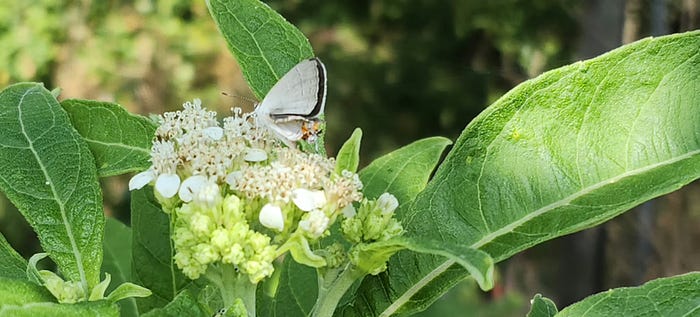
Pollinators, such as butterflies and bees, are attracted to Frostweed’s clusters of small white disc flowers that rise at the top of its sturdy stems. Each cluster, spanning 3–6 inches, is composed of numerous small ray and disk flowers, each having its own nectary, helpfully concentrating the nectar in one place. Combined with their flat, easily accessible structure, they provide a stable landing pad for large butterflies. With large, coarse, and ovate leaves along the stems, the plant showcases a bold presence even when not in bloom.
A Pollinator Powerhouse
The timing of Frostweed’s fall bloom period is critical, serving both resident insects stocking up for the winter and migratory species needing a fueling stop. One of these migrating pollinators is the Monarch Butterfly, as it travels south to Mexico. But its bounty does not end there; a variety of other butterfly species, such as Pipevine Swallowtails and Great Purple Hairstreaks, as well as numerous native bees and European honeybees, also flock to its flowers. Beyond providing nectar, Frostweed is a host plant for the caterpillars of Summer Azure, Bordered Patch, and Silvery Checkerspot butterflies.
Frostweed’s value to local ecosystems continues long after its flowers fade. After blooming, the ripened seeds are an important winter food source for birds, including finches and sparrows. In addition, the robust stems provide an overwintering site for a variety of insects, thus supporting the biodiversity of local ecosystems.
Frostweed’s Icy Pageant
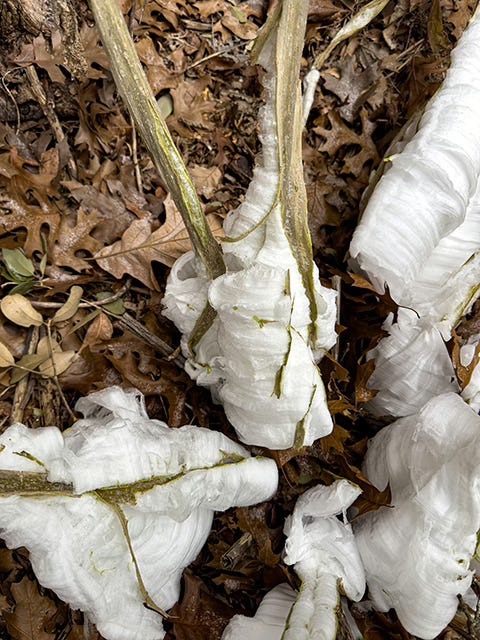
The origin of Verbesina virginica’s common name is triggered by the year’s first frost. That is the signal for them to put on their showy display as their stems rupture and spill out sap, which freezes into delicate, ribbon-like sculpture. Emanating from the bottom of the stems, these “ice ribbons” or technically “crystallofolia”, appear in shapes as unique as each plant. But do not delay in witnessing their spectacular display, as it disappears quickly if the temperature rises above freezing.
Naturalizing in the Home Landscape
For homeowners, Frostweed represents a highly practical choice due to its inherent resilience. With the ability to spread by seed and rhizome, it makes an excellent backdrop when wildscaping, but is not well-suited for more formal gardens. With plenty of room to grow and spread, it is an ideal understory flowering perennial because of its tolerance for shade and tall form. As a native wildflower, it requires minimal care once established and is largely free of pests and disease.
Including Frostweed into your landscape is relatively straightforward, but there are some decisions to be made. Depending on your goals and local environment, Frostweed can benefit from a timely pruning. Many native gardeners prefer to prune their plants by one-third to one-half in early summer to encourage shorter, fuller growth. This mostly depends on the amount of sun received; with less sun, it will usually grow taller and sparser. Another decision is on deadheading the plant. While it is beneficial to local birds not to remove the seeds, if you are constrained in space, removing some or all seeds may be necessary to keep the plant contained. Lastly, leave the stems until spring, but if you must remove, leave at least 18 inches for stem-nesting bees.
If you are looking to add Frostweed to your landscape, it is usually available at native plant sales and from specialty native plant nurseries. Frostweed offers local ecosystems a wealth of benefits that span all seasons, exemplifying what native plants do best: sustain life.
This article was originally published with the Native Plant Society of Texas.

 Tim Castelli
Leave a comment